Most of us have heard the saying, “Comparison is the thief of joy”. So, if this principle is widely known, why do I keep comparing myself to others? As I reflect on the comparisons I’ve been making, I feel called to explore how, even as people who have prioritised self-development, we can fall into the trap of comparing our lives, careers, homes, appearances and even identities with others.
Social media is a comparison trap
Have you ever been caught in a “scroll hole”, as it’s often referred to, where your finger automatically scrolls through Instagram, TikTok or Facebook for hours? After it happens, how do you feel? I know that I feel depleted of energy and often come away hyper-focused on how my present reality compares to what I’ve just watched. I look around my house after my favourite influencer makes coffee in their picture-perfect kitchen, arranges the luxury cushions on their sofa and settles into their calm and beautiful bedroom with a herbal tea, to notice the damp spot in the corner of my conservatory, the bright pink walls in my bedroom that I hugely regret painting, and the near-empty rooms that we can’t furnish until after our wedding. It makes me think that my current reality isn’t good enough and, subsequently, I’m not good enough.
Of course, most of us know that the montage of footage we see on social media is a carefully curated and filtered version of a person’s life. We all get dirt in our homes, have made a big purchase or home “improvement” that we’ve regretted, or felt that we can’t keep up – even the most successful of influencers are competing with their peers to achieve bigger, better and more.
Perfectionism aids comparison
Then there’s perfectionism, which, when tied with the comparison you’re making to a person’s showreel on social media, can maximise the feeling. In my bright pink bedroom, not only am I fixated on the fact that I don’t like the colour, but I’m hindered by the quality of the paint job. With antique skirting boards that have been thickened by years of paint, I fixate on the fact that they don’t look like those of a show home.
Then, I have to remember that A. I’m not a professional painter and decorator, and B. I live in a house that was built in 1904. Why should I expect my workmanship to be that of a professional, and even then, for a professional to be able to conceal my uneven, quirky walls to show home standard? You can read about overcoming perfectionism in my blog post.
Goals and values get forgotten
My mental health took a dip at the beginning of 2025, which I talk about in my blog post about slow living. I lost sight of who I was, what I stood for and where I was going, rather ironically after setting up a planner packed with personal goals for the year.
I was stuck in the comparison trap, fuelled by social media and my overbearing schedule, making purchases that were out of alignment with who I truly was. It was humbling to realise that, even as someone who practices intentional living, I lost my way. Why? Because I forgot to do the one fundamental principle of this lifestyle – give myself room to be.
What is comparison teaching you?
Falling off the path of my goals happens to me more often than I’d like to admit, from scrolling TikTok in bed because I’ve neglected my loving practice of journaling and reading, to spiralling into a vortex of Etsy favourites for my wedding when I’m supposed to be winding down. Comparison underpins both of these activities.
My favourite influencer’s vlog highlights the dream I have of my own social media account – one that I have failed to put into practice. The “perfect” wedding I’ve seen on TikTok with a £300,000 budget becomes the benchmark for my own. But, comparison is often masking something deeper – fear. Fear that I will never be brave enough to achieve my dream of starting my own social media account, and fear that my wedding day won’t be good enough.
I’m writing this publicly because, to overcome fear, I’ve needed to start looking at what the comparison I’m making is telling me to validate or invalidate the belief surrounding it. The formula can be replicated for your own social comparisons.
Does the person have something that you want?
Does what this person has align with your beliefs and values?
If yes, add it as a goal and start taking action.
If no…
What about this person is making you feel “less than”?
Is it true?
Example one
I’m making a comparison with an Instagram influencer who inspires me.
Does the person have something that you want?
Yes, my own social media account to help others.
Does what this person has align with your beliefs and values?
Yes, a social media account has been one of my goals since 2021.
Action: Put the goal at the top of my goals list with the next three to five steps, and take action on the first step.
Example two
I’m making a comparison with a celebrity’s big wedding.
Does the person have something that you want?
Yes, the “perfect” wedding.
Does what this person has align with your beliefs and values?
No, I always wanted an intimate wedding with my closest family and friends.
What about this person is making you feel “less than”?
I worry that people won’t have a good time at our wedding if it doesn’t have as many activities as the weddings I’m seeing on TikTok’s ‘For You’ feed.
Is it true?
No, my guests are expecting a wedding that’s authentically us, and none of the weddings I’ve personally attended had these things.
Action: Let it go.
Creating habits to stop comparing yourself
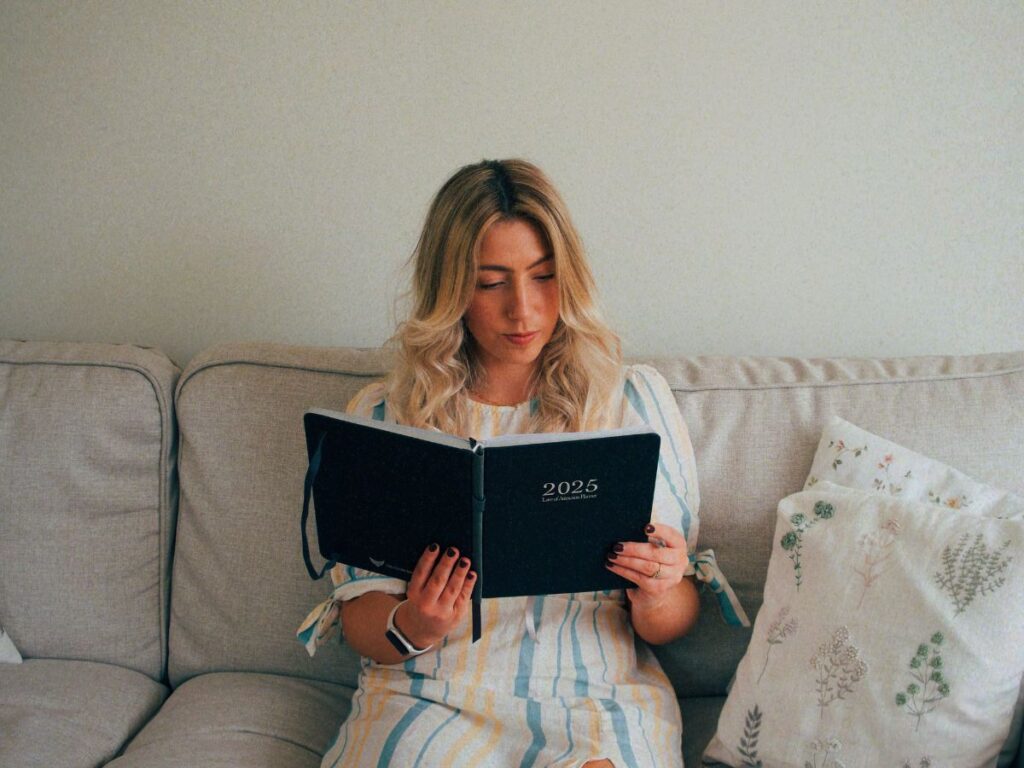
Think about the activities that light you up, rather than deplete your energy. To be on my best vibration, I know that one YouTube video in the bath is enough of a social media fix to keep me feeling fulfilled in the evening. So, rather than getting into bed and starting the bad habit of opening TikTok, I can spend 15 minutes reflecting on the goals in my planner. I use Freedom Mastery’s Law of Attraction Planner, which includes positive questions to ask yourself in the morning and evening. Then, I can leave an uplifting fiction book by my bedside to read, just before I turn the lights out.
What routine can you build to replace the habit that’s leading you to the comparison trap, and what can you do to remind yourself to do it? Journaling and reading are just two examples, but you can look at incorporating activities based on seasonal living, such as this list of summer activities for adults. There are a number of apps and in-built features in smartphones that provide prompts to time out before we begin to compare ourselves on social media.
Remember, comparison doesn’t mean failure. As human beings, we all do it – it’s a human survival mechanism. When you catch yourself in the act, make sure that you’re kind to yourself, and find room to breathe and listen to what it’s telling you under the surface. This way, you can learn how to get back on your path to the most intentional and aligned version of yourself.
As an Amazon Associate, I earn a small amount from qualifying purchases.
I think the arrival of social media definitely fed into the ability to compare ourselves to others. It enables us to see so many more people and what they choose to highlight and share than before it existed, and that can be problematic (giving the impression that so many more people than you have x,y,z, etc, etc). I think it’s great you looked at this objectively and decided to figure out your why. Identifying actions to take is a great way to tackle it.
Thank you for your thoughtful comment, Molly. The constant highlight reel on social media is one of the main reasons I deleted my personal Facebook, Instagram and TikTok accounts (a blog post to come on this decision soon!). ?
Nice post! I loved when you said comparison doesn’t mean failure. Sometimes it just takes us sitting back and appreciating what we already have.
I’m so pleased you liked it, Lesha. ✨
This is so true. Seriously. And why is it that people only compare in One Direction— to those they think are better off than them. Why do they not look in the other direction— to those that are worse off than them? And in some cases, much worse. Gaza, Ukraine and Sudan to name just three there are many many many others.
People should be grateful for what they have.
Allie of
http://www.allienyc.com
This is such an important point, Allie. Thank you for adding this perspective to the conversation. My thoughts are with all of those who are living through the war. ❤️